Engaging Learners with Dynamic Worksheet Weather, Temperature, Seasons
In the world of content creation and educational design, the difference between a passive learning tool and an active experience often comes down to visual strategy. When designing materials for children, whether for a classroom curriculum, a homeschooling resource pack, or a commercial educational product, the assets you choose dictate the engagement level. This is where the Worksheet Weather, Temperature, Seasons resource stands out. It is not merely a collection of printable pages; it is a comprehensive design system built to teach atmospheric concepts through interactive visual logic.
For designers, marketers, and publishers operating in the educational niche, understanding the value of a high-quality worksheet bundle is crucial. You are not just selling a PDF or a PNG file; you are selling a solution to a learning objective. The Worksheet Weather, Temperature, Seasons package offers a distinct personality that balances educational rigor with playful aesthetics. It moves away from the static, text-heavy worksheets of the past, embracing a style that relies on clear iconography and logical sequencing. This approach ensures that the content is accessible to young learners while remaining professional enough for publishers to brand as their own.
The Anatomy of an Effective Learning Asset
The true strength of the Worksheet Weather, Temperature, Seasons kit lies in its structured variety. As a creative professional, you know that "one size fits all" rarely works in design. This resource acknowledges that by providing a diverse range of activities that target different cognitive skills. It moves from simple recognition tasks to complex analytical exercises, creating a visual hierarchy that guides the student naturally through the subject matter.
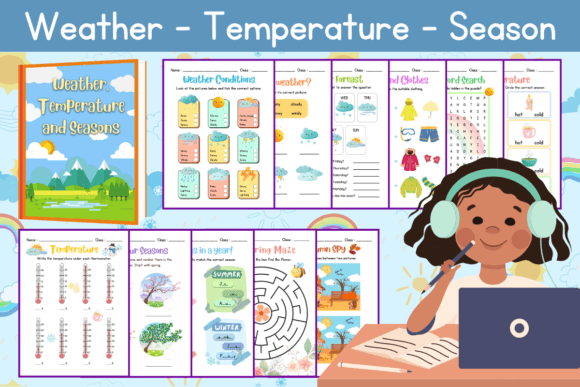
Consider the progression of the activities included in the unit. It begins with foundational visual recognition, asking learners to look at pictures and tick correct options—a standard for early-stage comprehension. However, it quickly escalates to applied logic. For instance, the "Weather Forecast" activity requires students to use a visual data set (the forecast) to answer specific questions. This mirrors real-world media literacy skills. Similarly, the "Weather and Clothes" matching game teaches association and cause-and-effect reasoning. From a design perspective, these activities rely on strong, unambiguous illustration to ensure the connection between the text prompt and the visual answer is seamless.
The inclusion of specific temperature activities—such as reading a thermometer and coloring based on temperature—adds a mathematical and scientific layer to the unit. For content creators in the ed-tech space, these are prime examples of cross-disciplinary design. You are combining graphic design with numeracy. The "Winter Symmetry" and "Spring Maze" activities further expand this by introducing spatial awareness and fine motor skills. A well-designed worksheet uses grid lines and visual guides not as clutter, but as invisible scaffolding that supports the user's success.
Strategic Applications for Creatives and Publishers
If you are a small business owner or a creative entrepreneur looking to break into the educational market, a resource like Worksheet Weather, Temperature, Seasons is an invaluable design asset. However, the value is maximized when you view it through the lens of brand identity. How does this worksheet set fit into your broader collection?
For a blogger or content creator specializing in parenting or education, this package serves as a lead magnet. You can offer the "Weather Word Search" or "Autumn Spy" (spot the difference) as free downloads to build your email list. The visual style of these worksheets should ideally match your website’s web design aesthetic. If your brand uses a clean, modern look, you can easily overlay these activities onto branded backgrounds or integrate them into digital planners.
For publishers and designers creating physical goods, the print design potential is significant. The files are provided in formats that allow for high-resolution output, which is essential for packaging design or premium workbook printing. When you are assembling a physical book, consistency is key. The visual language used in the "Four Seasons" naming activity needs to feel cohesive with the "Color Thermometer" exercise. This resource provides that consistency, acting as a modular set of design assets that can be rearranged to suit specific curricula or seasonal campaigns.
Leveraging Visuals for Brand Perception
In a crowded market, the aesthetic of your educational materials contributes heavily to your brand identity. A generic, pixelated worksheet signals low value. Conversely, a clean, vector-based, and well-laid-out resource signals professionalism. The Worksheet Weather, Temperature, Seasons set leans into a style that is friendly yet structured. It uses whitespace effectively to prevent cognitive overload, a critical UX principle in editorial design.
When utilizing this resource, think about the font pairing and typography used in your headers or instructions. While the worksheet itself provides the core activity, your surrounding branding—the cover page, the table of contents, or the social media promotional graphics—needs to speak the same visual language. If the worksheet features rounded, soft illustrations, pairing it with a sharp, aggressive sans serif font might create dissonance. Instead, opting for a rounded display font or a friendly handwritten font for titles would harmonize with the educational theme. This attention to detail elevates a simple worksheet into a premium product.
Practical Guidance for Implementation
Integrating a multi-page unit like this into your workflow requires a strategy. Whether you are a teacher designing a lesson plan or a marketer creating a seasonal bundle, here is how to get the most out of the Worksheet Weather, Temperature, Seasons material:
- Digital vs. Print Optimization: The inclusion of .png files alongside .pdfs is a significant advantage for digital design. If you are building an interactive app or a digital classroom environment (like Google Slides or Seesaw), the PNGs allow you to drag and drop individual elements. You can isolate the "Thermometer" graphic to use as a standalone interactive element, separate from the worksheet context.
- Customization for Niche Markets: While the content is weather-focused, the format allows for repurposing. For example, the "Word Search" grid is a standard layout that could be adapted for vocabulary specific to a client's brand or a specific geographic region's climate. This flexibility makes the asset valuable for freelance designers serving diverse clients.
- Accessibility and Readability: Always review the contrast and line weight when scaling these assets. While the provided files are optimized, resizing them for different mediums (e.g., a large poster vs. a small flashcard) requires checking that the fine lines in the "Spring Maze" or "Autumn Spy" details remain legible. Good web design and print principles dictate that clarity trumps complexity.
Ultimately, the Worksheet Weather, Temperature, Seasons collection is more than just a set of busy work pages. It is a modular toolkit for teaching complex natural phenomena through visual interaction. By treating these worksheets as strategic design assets rather than disposable paper, creators, educators, and entrepreneurs can build engaging, professional, and educational experiences that resonate with their audiences and stand the test of time. Whether you are focusing on social media graphics